Home / News / Multi‑Condition Comparison & Practical Installation Tips for MMO Titanium Ribbon Anode + Titanium Conductive Strip Cathodic Protection System
Aug. 25, 2026
Featuring flexible coil supply, uniform current distribution and long service life, distributed anode systems composed of MMO titanium ribbon anodes and titanium conductive strips are widely adopted for ICCP impressed current cathodic protection for tank bottoms, buried pipelines, reinforced concrete and shallow‑submerged offshore steel structures. Material selection, installation methods and design parameters vary greatly among different working conditions. Direct copy‑paste of one solution easily causes abnormal system operation.
Tank bottom cathodic protection: MMO titanium ribbon works as current‑emitting anode, while titanium conductive strip serves as mesh collecting skeleton. Cross‑spot‑welded mesh anodes are laid on tank‑bottom sand bedding, normally without coke backfill. Typical current density 150‑200 mA/m, mesh spacing 2‑3 m. Strip‑type or radial circular layout is acceptable. Titanium conductive strip collects total mesh current. Titanium‑copper composite transition joints shall be sealed at outlets. Maintain proper gap between anodes and tank bottom plate to avoid current shielding.
Buried pipeline & plant pipe network cathodic protection: MMO titanium ribbon is laid parallel to pipelines. Titanium conductive strip parallels multiple anode segments for current collection. Coke backfill can be applied in trench‑laid condition to reduce anode ground resistance. It fits sites with heavily damaged coating, multiple parallel pipelines and high soil resistivity. Linear current‑output characteristic of strip‑type anodes effectively solves current‑shielding problems of conventional discrete anodes. Prevent sharp stones from scratching titanium ribbon surface during backfilling.
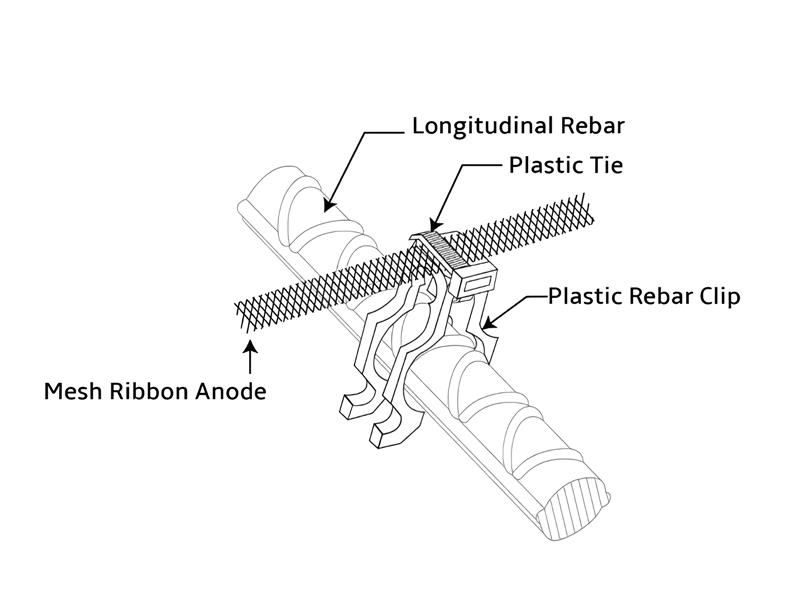
Reinforced concrete cathodic protection: MMO titanium ribbon anode shall adopt special iridium‑tantalum MMO coating for concrete oxygen‑evolution environment. Titanium conductive strip realizes large‑area current collection. For new‑build projects, anodes are pre‑embedded outside rebars with insulation spacing. For rehabilitation of aged structures, install ribbon in slotted grooves filled with conductive mortar. Strictly control operating current density; excessive current triggers alkali‑aggregate reaction and damages concrete matrix.
Shallow‑buried & tidal‑zone offshore steel‑structure protection: Seawater with high‑concentration chloride brings severe corrosion. MMO titanium ribbon anode adopts high‑stability iridium‑tantalum coating. Titanium conductive strip requires mechanical protection against wave abrasion. All joints adopt IP68 subsea anti‑corrosion sealed connectors. This solution is not suitable for deep‑sea high‑pressure conditions, where tubular MMO anodes are preferred.
General practical installation notes:
Avoid hard‑object scratching to MMO titanium ribbon anode coating during handling and laying. Coating damage becomes failure initiation point.
MMO titanium ribbon anode is dedicated for protective‑current emission; titanium conductive strip only for current collection. They cannot replace each other.
All titanium‑to‑titanium connections adopt titanium‑specific spot welding; conventional arc welding is forbidden.
Titanium‑copper composite transition joints are mandatory for cable outlets. Direct contact between copper and titanium ribbon is prohibited to prevent galvanic corrosion.
Complete loop continuity test and anode ground‑resistance measurement before commissioning, then adjust rectifier output parameters.
The core advantage of MMO titanium ribbon anode plus titanium conductive strip distributed anode system lies in flexible layout and customizable length specifications, solving many complex anti‑corrosion scenarios where conventional anodes perform poorly. During design phase, determine ribbon dimension, conductive‑strip cross‑section and mesh spacing according to soil resistivity, medium type and protected area, to fully realize long‑life material performance.