Home / News / Application of Distributed Shallow Anodes in Regional Cathodic Protection for Dense Piping Networks and Tank Farms
Apr. 01, 2026
In oil and gas stations, city gate stations, and chemical plant areas, the coupling interference between buried piping networks and grounding systems has long been a technical challenge in cathodic protection engineering. These facilities are characterized by dense piping layouts, limited space, and extensive grounding grids installed in accordance with safety codes, forming continuous low-resistance paths. When conventional deep-well anodes or remote anode beds are used for regional cathodic protection, the grounding grid often becomes the dominant current sink. A significant portion of the cathodic protection current is lost to the grounding system, leaving insufficient effective current density reaching the surface of the protected pipes.
A typical case occurred at a gas compressor station. Five years after commissioning, corrosion perforation was found on buried piping. Testing revealed that the protection potential was severely inadequate. The original design adopted two deep-well anodes with a depth of 60 meters and spacing of 80 meters. Theoretical calculations indicated that the configuration would meet the protection current requirement. However, after the system was put into operation, with the rectifier output set at 30 A, the ON-potential on pipes near the anode wells reached –1.80 V (CSE), indicating overprotection. At a distance of 120 meters from the wells, the potential was only –0.85 V (CSE), barely meeting the protection criterion. Further away, the potential dropped below –0.70 V (CSE), leaving those pipes completely underprotected. Field measurements showed that of the 30 A output from the rectifier, more than 25 A was shunted through the grounding grid, leaving less than 5 A effectively applied to the piping. The current utilization rate was below 20%. This phenomenon is known in engineering as grounding shielding.
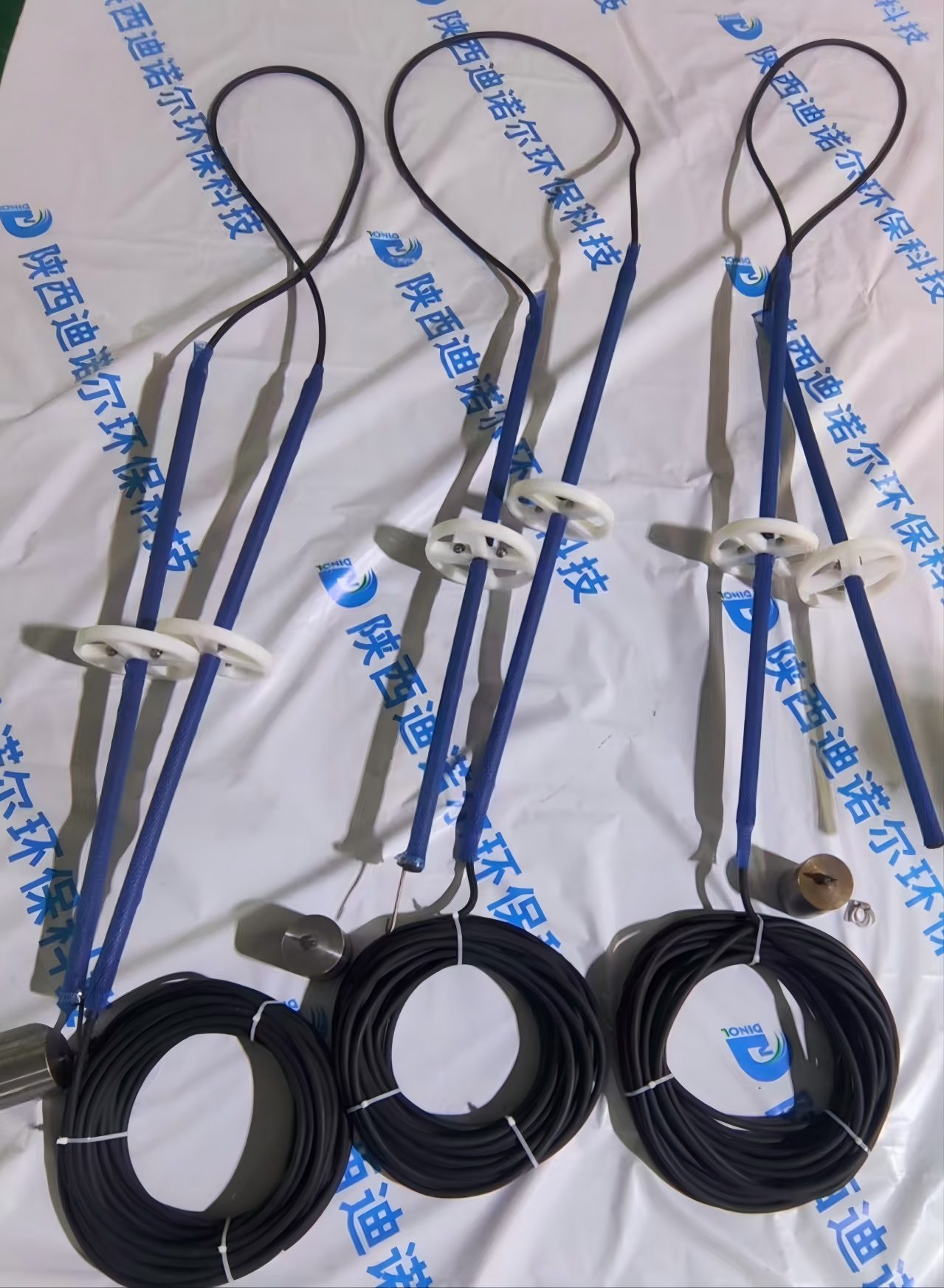
To address this issue, a distributed shallow anode scheme was adopted instead of deep-well anodes. The selected anode was a Φ25×1000 mm MMO tubular anode with a 1×16 mm² cable. Using hand augers or small drilling rigs, shallow holes 5–8 m deep were drilled in gaps between pipe racks and equipment foundations. The hole spacing was controlled between 8 and 15 m depending on site conditions. Each hole received one anode, which was backfilled with calcined petroleum coke. Multiple anodes were connected in series and tied to the rectifier output.
The technical advantages of this distributed shallow anode arrangement are as follows:
1. Effective mitigation of grounding shielding. Placing anodes in close proximity to the protected pipes disperses current discharge points. Current is injected directly near the pipes, bypassing the low-resistance path of the grounding grid. Operational data showed that with the distributed anode system outputting 15 A, the pipe potentials across the station were uniform, stabilizing between –0.90 V and –1.20 V (CSE). Current utilization increased to over 70%.
2. High installation flexibility with minimal interference to existing facilities. The small diameter of the Φ25 mm anode requires only 150–200 mm boreholes. Heavy machinery is not needed, and construction can be carried out without shutting down the station. For retrofit projects in existing stations, this approach significantly reduces the risk of damaging underground utilities or surface pavement.
3. Controllable ground resistance with coke backfill. In station areas where soil resistivity is typically below 50 Ω·m, a single anode with coke backfill achieves a ground resistance between 5 and 15 Ω. When multiple anodes are connected in parallel, the total ground resistance decreases further, and the rectifier driving voltage generally remains below 25 V, ensuring stable operation.
4. High reliability of cable sealing. The connection between the anode and the 1×16 mm² cable is sealed using heat-shrinkable tubing combined with epoxy potting. This sealing technique maintains insulation integrity during long-term burial, preventing open-circuit failures caused by joint degradation.
Previous: None