Home / News / Field Installation of Deep Well Anodes – Details Where Things Often Go Wrong
Apr. 29, 2026
A nice design drawing is one thing. On site, when you start drilling, lowering the anode, and backfilling, a moment of carelessness can cause a whole series of problems. I have visited many sites – seen deep wells where grounding resistance would simply not come down, cables that broke after only half a year of operation, backfill that wasn’t consolidated and caused local heating and burnout after power‑up. The truth is, deep well anode installation is a precise job – there are a dozen steps, and every one of them can hide a trap.
Below I will go through the key points we have learned from installing dozens of deep wells. These lessons were earned the hard way.
1. Before mobilisation – don’t rush the drilling. Inspect the materials and re‑survey the ground first.
When the pre‑packaged anode arrives on site, don’t just check that the packaging looks intact. Open it. Check whether the internal backfill has noticeably segregated. Look for impact damage or cracks on the anode body. For high silicon cast iron, confirm the silicon content with the manufacturer’s report. For MMO anodeshttps://dinoer-anodes.com, carefully inspect the coating for scratches – a scratch in the titanium is not a big problem, but if the coating is scraped off, that anode is ruined.
Also, you must do an on‑site measurement of soil resistivity with depth. The geotechnical report from the design institute might be from six months earlier, or the drill hole might be 200 metres away – resistivity can easily double. On one project we didn’t re‑measure, drilled according to the design value, and could not get the grounding resistance below 2 Ω no matter what we tried. When we finally measured the deep‑layer soil we found the resistivity was 60% higher than the report said. We ended up drilling another well beside it – an extra cost of more than 100,000 yuan.
Select a location away from existing pipelines, waterlogged areas, and overhead power lines. The distance to the protected pipeline should generally be no less than 80 metres – any closer and you risk over‑protection; any farther and you lose too much current.
2. Drilling and cleaning – verticality and sediment are the two critical points
Drilling is usually done with a mud‑rotary rig. The hole diameter follows the design – common sizes are 200 mm to 300 mm. For medium‑deep wells deeper than 50 metres, you should check verticality every 10 metres (of course the well isn’t that deep, so check every 10 metres anyway) and keep the deviation within ±2°. An experienced operator can achieve ±1°. If the hole leans too much, the anode will scrape the wall while being lowered, or even get stuck halfway.
Cleaning the hole is often neglected. After drilling, the hole is full of mud and rock cuttings. You must use reverse circulation to pump the sediment out. The acceptance standard is that sediment thickness should be no more than 50 mm. How do you check? Tie a weight to a measuring tape, lower it to the bottom, pull it up, and see how much debris is stuck to the tape. If you don’t clean the hole properly, the anode will be supported by the sediment instead of sitting at full depth, and the mixture of sediment and coke backfill will have horrible resistivity.
3. Lowering the anode – slow is fast
Pre‑packaged anodes are usually delivered in sections, each two or three metres long, joined by threads or clamps. Never, ever use a steel cable to lift the anode body directly. Never use the cable as a lifting sling – we once pulled a cable apart and the whole anode dropped down the hole; we had to hire a fishing crew to retrieve it. Use nylon slings cradling the bottom of the anode and lower it very slowly, at less than half a metre per minute, and use centralisers to keep the anode centred in the hole.
With each section lowered, connect the vent pipe. The vent pipe is often ignored. The anode produces a small amount of gas when it operates; if the gas cannot escape, the gas resistance increases the anode potential, accelerating consumption and even causing failure. The vent pipe must run all the way to above the wellhead, exposed for at least 300 mm, with the outlet turned downward or fitted with an elbow to keep rainwater out.
The cable should be routed inside the vent pipe – this is an important detail. If the cable is left loose in the backfill, the insulation can easily be crushed by coke particles during backfilling, leading to current leakage after some time.
4. Backfill with coke – density determines grounding resistance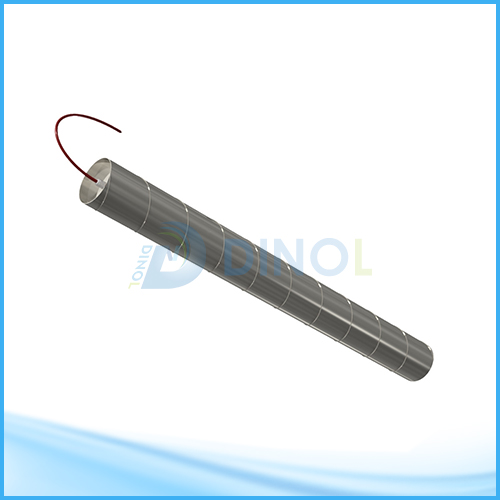
Coke backfill is key to lowering grounding resistance. We generally use metallurgical coke with particle size 3‑10 mm and carbon content above 98%. Fill from the bottom of the hole upwards, in layers of 400–500 mm, and tamp each layer thoroughly. Use a vibrator that reaches into the backfill, moving it up and down to eliminate voids. Some people pour in two or three metres at a time to save time – then when they measure grounding resistance after energising, it is double the design value. Later excavation shows hollow pockets everywhere.
You can also mix a small amount of gypsum or industrial salt into the coke to keep it moist and lower resistance, but control the dosage – too much will accelerate anode consumption or contaminate groundwater. Leave the top 500 mm of the annulus to be backfilled with plain soil, compacted layer by layer. Finally, make a concrete collar around the wellhead at least 150 mm high to prevent surface water from flowing in.
5. Cable connections – the most inconspicuous place where failures often start
The connection between the anode cable and the header cable – if it is not done well, it will heat up, oxidise, and open up a few years later. We mandate exothermic welding (aluminothermic). The contact resistance of the welded joint must be less than 0.01 Ω. If field conditions do not permit exothermic welding, you may use a copper compression lug and a hydraulic crimper, crimping at least three times. Whichever method you use, the joint must be double‑sealed against moisture: first wrap with self‑amalgamating tape, then cover with heat‑shrink tubing and shrink it, and finally brush on a coat of epoxy coal‑tar enamel.
Before connecting the cable to the rectifier, measure the insulation resistance to ground – it should be at least 20 MΩ. When connecting, double‑check the polarity repeatedly – the anode goes to the positive terminal of the rectifier, the pipeline to the negative. Someone in a hurry has reversed the polarity before. After power‑up the anode current shot up within half an hour, and only then did they realise the mistake – the consumption that anode suffered in that short time was equivalent to years of normal operation.
6. Acceptance and commissioning – don’t just look at numbers, make the system run
After installation is complete, don’t rush to sign the acceptance form. First measure the deep well anode’s resistance to ground. A typical acceptance criterion is less than 1.8 Ω (standards vary, but a deep well should be much lower than a shallow groundbed). Then start the rectifier, manually adjust the output, and see whether the pipe‑to‑soil potential can be stabilised between –0.85 V and –1.2 V (CSE). If you cannot reach that range, or if you need a very high output current to maintain it, something is wrong – either the grounding resistance is too high or the distance is too large.
Finally, remember to put a permanent marker on the wellhead, recording the drilling date, anode type, depth, and cable routing. I have seen a pipeline retrofit three years later – the excavator cut a cable and nobody knew which well it belonged to, and it took a huge effort to trace it. Collect all construction records, test reports, and photographs, bind them into a file – that becomes the basis for future operation and maintenance.
Seven things you must never do
Never remove the factory packaging from a pre‑packaged anode and install it bare – the backfill will be lost and the anode will fail quickly.
Never use crushed stone, frozen soil, or construction debris as backfill – their resistivity is hundreds of times higher than coke.
Never block or bury the vent pipe – after a few years of operation gas resistance may crack the anode.
Never pour the whole backfill in one shot – without consolidation, it is as good as not being filled.
Never blindly increase the rectifier output current – the anode consumption rate rises exponentially with current.
Don’t shut the vent pipe outlet – the anode may polarise and fail.
Don’t leave the cable connection poorly sealed – moisture ingress will cause gradual failure.
Working on deep well anode installation requires the same patience as drilling a water well. From drilling to energising, a single well can take two or three days for a straightforward job, or a full week for a challenging one. But remember – that well is going to stay underground for two decades. Spending an extra half hour today to properly tamp the backfill means ten fewer maintenance trips later. That arithmetic never loses.