Home / News / Segmented Insulation and Drainage Control for MMO Anode Strips in Stray Current Areas
May. 08, 2026
Isolation Strategy for a 50‑Metre Exposed Cable Lead Under Dynamic Stray Current Conditions
Buried pipelines near rail transit systems or DC transmission lines are subject to dynamic stray current interference. In impressed current cathodic protection systems, the auxiliary anode ground bed itself can become a sink for stray current. This article describes the special treatment of an MMO tubular anode strip with a long lead cable in such environments.
In this configuration, a 50‑metre MMO tubular anode strip serves as the discharge element, while a 50‑metre length of 1×16² mm² cable is used as an isolating lead. The key design feature is that the exposed cable is not merely an extension; rather, by segmental shielding or buried insulation, the insulation resistance of the cable outer jacket to earth is artificially increased. Specifically, the cable outer jacket is of thick HDPE type, and over the entire 50 metres from the rectifier terminal to the anode strip, the cable must not make any electrical connection or contact with any metallic structure (such as pipelines, casings, or grounding grids).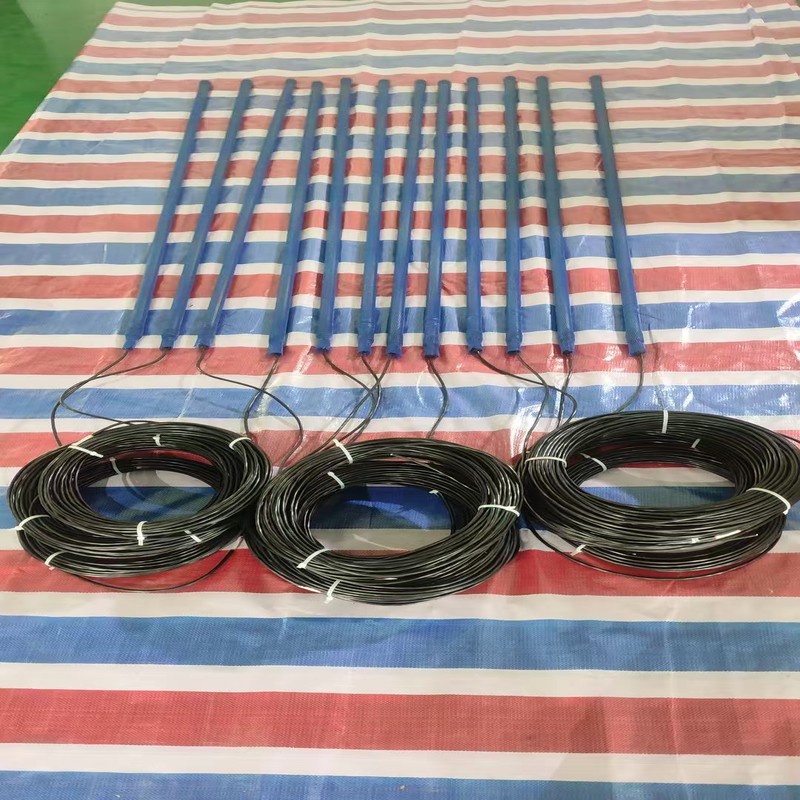
The technical principle is as follows: when stray current potentials fluctuate near the pipeline, the anode ground bed potential fluctuates accordingly. If the lead cable has any leakage point to earth (e.g., a damaged jacket or direct contact with a grounding system), the fluctuating current can enter the cathodic protection circuit via the cable shield or direct soil coupling, interfering with the potentiostat sampling signal. The practical requirement of a 50‑metre exposed cable means that this section is placed directly in the soil, but its insulation must remain intact, and no dedicated drainage ground bed is allowed.
During installation, the MMO anode strip is placed in a dedicated ground bed at least 50 metres away from the pipeline, while the 50‑metre cable is routed through a PVC protection conduit. Before backfilling, the insulation resistance between the cable core and earth should be measured with a 500 V megohmmeter; the value must be no less than 100 MΩ. During commissioning, a data logger should be used to simultaneously record anode current and pipe potential fluctuations. If the anode current varies at a frequency similar to that of the nearby traction current (0.1 to 10 Hz) but the pipe potential fluctuation amplitude remains below 50 mV, the isolation is considered successful. If fluctuations exceed that level, a polarisation drain device or grounding cell should be added along the 50‑metre cable path to divert the stray current to a dedicated ground electrode rather than allowing it to discharge into the pipeline system via the anode strip. This approach isolates the interference source without adding extra anodes and ensures proper logic operation of the potentiostat.
Notes:
CSE = copper/copper sulfate reference electrode.
NACE SP0169 = a standard of the National Association of Corrosion Engineers.
IP68 = ingress protection rating.
HDPE = high‑density polyethylene.
PVC = polyvinyl chloride.
All data ranges (e.g., 0.18 V/100m voltage drop, ±5% current density variation) are typical calculated values from engineering practice